P3How we deliver · UK manufacturers
How do you replace an old order system without stopping the factory?
Modernising manufacturers with AI and MCP
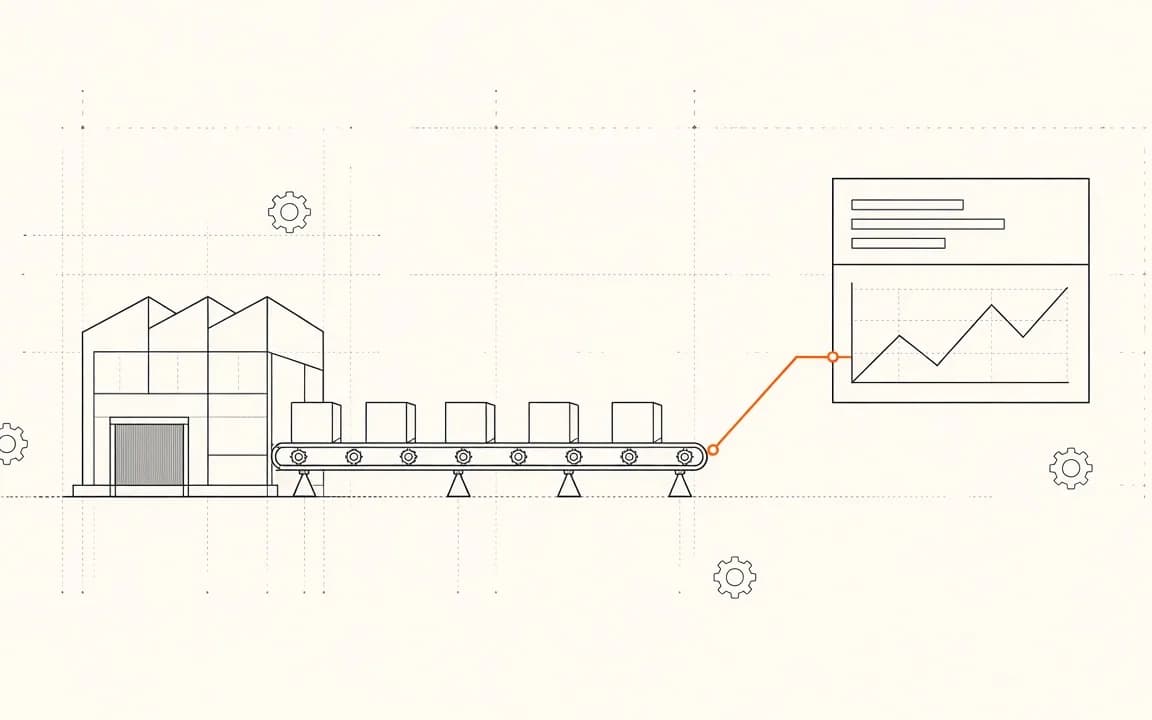
For a manufacturer running orders through an ageing in-house system and a lot of re-keying, we assess the system, rebuild it in stages without stopping production, join it to the ERP and couriers, automate order intake with AI, and add an MCP server so staff can query their own data.
- Who it is for
- UK manufacturers
- Sector
- Manufacturing and engineering
- Size
- Large company
- Services
- 5 services, joined up
P3.1
The usual starting point
Orders arrive as emails, PDFs and spreadsheets and are typed by hand into a legacy system that only a couple of people still understand.
The order system, the ERP and the courier accounts do not talk to each other, so stock and delivery dates are checked by phone.
Managers wait on weekly reports to answer simple questions about orders, stock and lead times.
P3.2
The system at a glance
What we build, what it connects to, and who uses it.
What we buildAI intake
AI intake · match and flag
We build and look after this part.
- 04 · Build AI order intake: AI automation
- 07 · Ongoing Tuning and new formats: AI automation
The diagram in words
- Orders in, email, PDF, CSV (existing system)
- AI intake, match and flag (what we build)
- Order clerk, approves (people)
- Order system, modern rebuild (what we build)
- ERP, stock, pricing (existing system)
- Couriers, labels, tracking (existing system)
- MCP server, read-only (what we build)
- Managers, plain questions (people)
Connections:
- Orders in → AI intake
- AI intake → Order clerk (AI at work)
- AI intake → Order system (AI at work)
- Order system → ERP
- Order system → Couriers
- Order system → MCP server
- MCP server → Managers (AI at work)
P3.3
How we deliver it, stage by stage
Discovery, build, launch, grow and ongoing: each step and the service behind it.
- 01 · Discovery · Legacy assessment
Code audits
Review the legacy code, data and integrations, find the rules the business relies on that nobody has written down, and agree a staged plan that keeps production running.
Touches: Order system
- 02 · Build · A staged rebuild
Custom software development
Rebuild the order system as modern software one area at a time, running old and new side by side and comparing results until each area is proven.
Touches: Order system
- 03 · Build · ERP and courier integration
API development and integration
Connect the new system to the ERP for stock and pricing and to courier accounts for labels and tracking, with retries and alerts when another system is down.
Touches: ERP, Couriers, Order system
- 04 · Build · AI order intake
AI automation
AI reads incoming orders in any format, matches customers, part numbers and prices, and queues each order for a person to approve, with anything unusual flagged.
Touches: Orders in, AI intake, Order clerk
- 05 · Launch · Switch-over by area
Custom software development
Move each area across at a quiet point in the week with a tested way back, then retire the old system once the last area is proven.
Touches: Order system
- 06 · Grow · Ask the data
MCP server development
Build a read-only MCP server over orders, stock and lead times, so approved staff can ask an AI assistant plain questions and get answers with links to the records.
Touches: MCP server, Managers
- 07 · Ongoing · Tuning and new formats
AI automation
Review the orders people correct each month, use them to improve matching, and add new customer order formats as they appear.
Touches: AI intake, Order clerk
P3.4
How the services connect
Why one partner across every stage matters.
- Because we rebuild the order system ourselves, AI intake writes into it through a proper interface rather than a fragile screen-scraping bolt-on.
- The same clean data model feeds the integrations and the MCP server, so an assistant's answer matches what the ERP and the courier show.
- The assessment shapes everything after it: the undocumented rules it uncovers become tests the new system has to pass.
P3.5
How we work with your team
- Governance
- A monthly steering meeting with operations, finance and IT, a shared risk log, and a go or no-go check before each switch-over.
- Data protection and security
- Role-based access, a read-only MCP server with an audit log, customer data kept in the UK, and AI providers chosen for no training on the data.
- With their team
- Pair with the in-house IT team throughout, so they can run, change and extend the system themselves.
- Change
- Order clerks help design the approval screen and test each release before it goes live.
P3.6
What you get
- Order clerks approve orders instead of typing them, and spend their time on the exceptions.
- Stock and delivery dates come straight from the ERP and courier systems, without phone calls.
- Managers answer everyday questions about orders and stock themselves, without waiting for a report.
- The legacy system is retired without stopping production.
Built for small teams too. A smaller firm can start with AI order intake on its existing system, without a rebuild.
P3.8
What you can check
The standing promises behind this work, and where to read them.
Accessibility to WCAG 2.2 AA
We design and test to WCAG 2.2 AA, by keyboard and screen reader as well as by tools, and help you keep an accessibility statement.
How we work →UK GDPR and DPIAs
Personal data is part of the specification: what is processed, why, where and for how long. We help you run a DPIA when a project needs one.
Security and trust →Hosting region
Hosting in UK data centres or on your own infrastructure, and AI providers set up not to train on your data.
DevOps and hosting →Handover documents
Code in your repositories, plus a runbook and documentation written as we go, so your own team or another supplier could pick it up.
Code ownership →Support terms
Support with agreed response times, monitoring and security updates, set out before work starts.
Support and maintenance →We run this ourselves
DeskZap is hosted, monitored and supported by us, so the way we look after your system is how we look after our own.
See DeskZap →
P3.9
Technology and timescale
Staged modernisation over several phases, then monthly tuning.
P3.10
Services covered
T+99Next step
Talk it through with us
A free 30-minute first chat, with no obligation. Tell us what is getting in the way; we tell you honestly what we would do, roughly what it would take, and whether it is worth doing at all.