P6How we deliver · SaaS start-ups
How does a start-up go from a first version to a SaaS product that scales?
Building and scaling SaaS products for start-ups
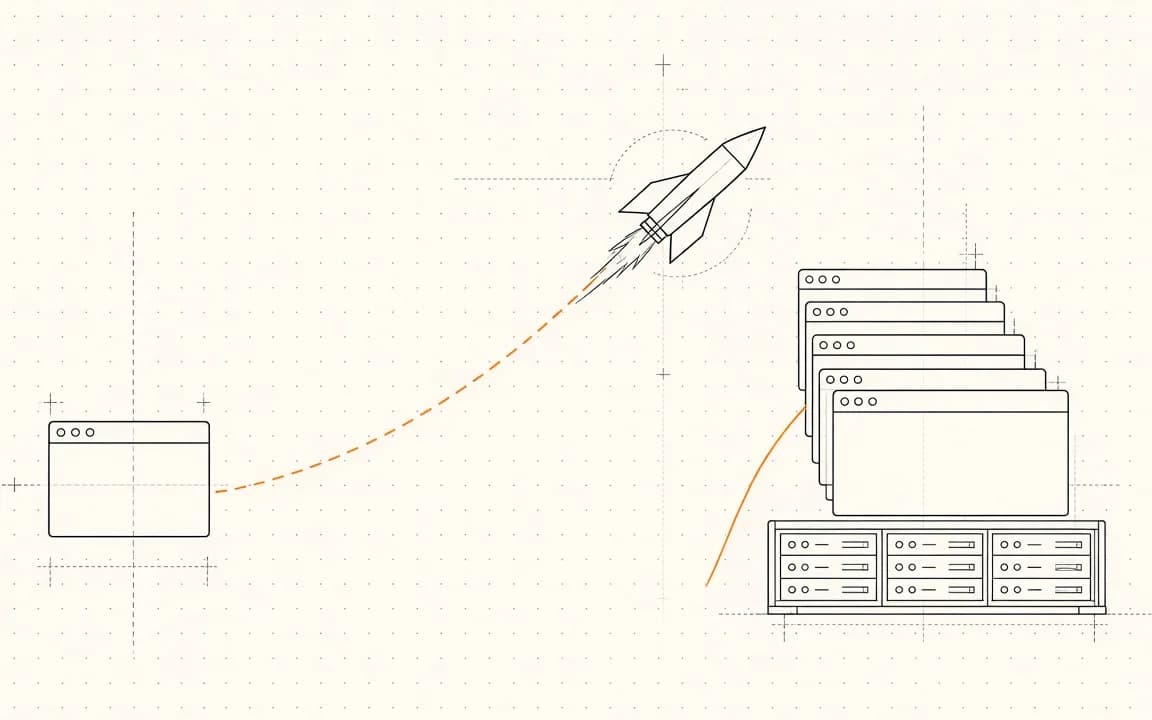
For a start-up with a clear idea, a few keen customers and no developers, we build a focused first version, turn it into a multi-tenant SaaS product with billing, add an MCP server for customers' AI assistants, then host and support it as it grows.
- Who it is for
- SaaS start-ups
- Sector
- B2B software
- Size
- Small business
- Services
- 5 services, joined up
P6.1
The usual starting point
The founders know their problem well from years in the industry, but have no developers and a limited budget to prove the idea.
Early customers want to try it quickly, then expect the security, reliability and integrations of an established supplier.
Their customers are starting to ask whether the product will work with the AI assistants their staff already use.
P6.2
The system at a glance
What we build, what it connects to, and who uses it.
What we buildWeb app
Web app · scheduling
We build and look after this part.
- 02 · Build The first version: MVP development
- 06 · Ongoing Support as it scales: Support and maintenance
The diagram in words
- Customer team, office and field (people)
- Web app, scheduling (what we build)
- Engineer view, job sheets (what we build)
- Core service, multi-tenant (what we build)
- Billing, subscriptions (existing system)
- MCP server, scoped, audited (what we build)
- AI assistants, customers' own (existing system)
Connections:
- Customer team → Web app
- Customer team → Engineer view
- Web app → Core service
- Core service → Billing
- Core service → MCP server
- MCP server → AI assistants (AI at work)
P6.3
How we deliver it, stage by stage
Discovery, build, launch, grow and ongoing: each step and the service behind it.
- 01 · Discovery · Scoping the first version
MVP development
Work with the founders and their first customers to choose the smallest set of features that will prove the idea, and write down what will wait.
Touches: Customer team
- 02 · Build · The first version
MVP development
Build the core features in short cycles, such as scheduling, a mobile view for engineers and digital job sheets for a field service product, with the first customers testing each release.
Touches: Web app, Engineer view, Core service
- 03 · Launch · Production-ready hosting
DevOps and hosting
Set up hosting with automated deployments, backups, monitoring and separate test and live environments, so releases are routine rather than risky.
Touches: Core service
- 04 · Grow · From product to SaaS
SaaS development
Add multi-tenant accounts, roles, self-service sign-up, subscription billing and an admin console, so new customers can start without the founders setting them up by hand.
Touches: Core service, Billing
- 05 · Grow · Works with AI assistants
MCP server development
Build an MCP server so customers' AI assistants can look up jobs, find free slots and draft bookings, within each customer's permissions and with an audit log.
Touches: MCP server, AI assistants
- 06 · Ongoing · Support as it scales
Support and maintenance
Support the product under an agreed service level, with security updates, performance work as customer numbers grow, and a shared roadmap with the founders.
Touches: Web app, Core service
P6.4
How the services connect
Why one partner across every stage matters.
- The first version is built on foundations meant to last, so turning it into a SaaS product extends it rather than starting again.
- The MCP server uses the same permissions and audit trail as the app itself, so AI access is no riskier than a person signing in.
- The team that builds it hosts and supports it, so incidents, fixes and new features are handled by people who know the code.
P6.5
How we work with your team
- How we worked
- Fortnightly releases, a shared roadmap the founders own, and demos with their customers rather than slide decks.
- Data protection and security
- Tenant data separated by design, UK hosting, encryption in transit and at rest, and the security answers larger customers ask for written up once.
- Ownership
- The founders own the code, the cloud accounts and the domain from day one.
- With their team
- When the start-up hires its first developer, we pair with them and hand over areas of the code step by step.
P6.6
What you get
- The founders put a working product in front of customers early, and learn from real use before building more.
- New customers sign up, pay and get started without the founders setting them up by hand.
- Customers can use the product from the AI assistants their staff already work in.
- Releases are routine, and the founders spend their time on customers rather than servers.
Built for small teams too. Made for small founding teams: a first version in short cycles, then growth when customers ask for it.
P6.8
What you can check
The standing promises behind this work, and where to read them.
Accessibility to WCAG 2.2 AA
We design and test to WCAG 2.2 AA, by keyboard and screen reader as well as by tools, and help you keep an accessibility statement.
How we work →UK GDPR and DPIAs
Personal data is part of the specification: what is processed, why, where and for how long. We help you run a DPIA when a project needs one.
Security and trust →Hosting region
Hosting in UK data centres or on your own infrastructure, and AI providers set up not to train on your data.
DevOps and hosting →Handover documents
Code in your repositories, plus a runbook and documentation written as we go, so your own team or another supplier could pick it up.
Code ownership →Support terms
Support with agreed response times, monitoring and security updates, set out before work starts.
Support and maintenance →We run this ourselves
DeskZap is hosted, monitored and supported by us, so the way we look after your system is how we look after our own.
See DeskZap →
P6.9
Technology and timescale
A first version, then steady fortnightly releases.
P6.10
Services covered
T+99Next step
Talk it through with us
A free 30-minute first chat, with no obligation. Tell us what is getting in the way; we tell you honestly what we would do, roughly what it would take, and whether it is worth doing at all.